
Tahir Kamran, Political Economy November 13, 2016
Kissan Conference at Toba Tek Singh
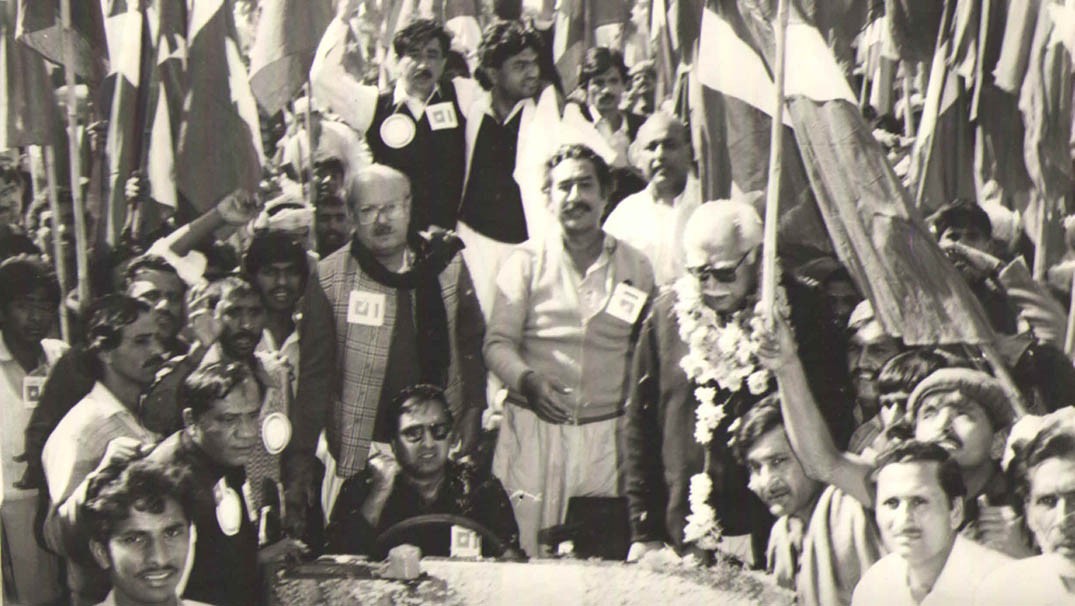
According to Ahmad Bashir, as the Kissan Conference at Toba drew closer, the government did all that was possible to thwart it.
In all villages and towns of the time, kabbadi was a really popular game. Cricket had yet to make its inroads in the rural vicinities of the colony districts. Therefore kabbadi matches used to draw enormous number of spectators. The government thought of making use of people’s fondness for the game to divert the peasants from joining the Kissan rally. Various tournaments were organised in many villages on March 22, 1970 under the auspices of the Education Department.
In Chiniot and Lalian, disinformation was spread that the conference had been postponed and, along with that announcement, kabbadi competitions were zealously advertised. Shafqat Tanvir Mirza mentions one Major Gama from Toba Tek Singh who was a beneficiary of Ayub Khan’s rule and had taken it upon himself to drive around in various villages, from dawn to dusk, telling people about the postponement of the conference.
Maulana Bhashani arrived at Toba Tek Singh railway station in the evening and was heartily welcomed by the workers and the general public. The overall mood was celebratory. People of the host city had opened up their houses for guests congregated from all across Pakistan to attend the moot. In most cases, the guests were totally strangers to those with whom they had come to stay.
Tandoors (earthen ovens) were set up in a large number, where one roti (a piece of bread) could be purchased for one anna and dal (lentil) was free with a roti. In Toba’s famous Allah Rakha’s Bagh, it seemed as if a whole city of small and big tents (chholdari) was set up.
Read also: A missing link
The spectacle was unbelievable unless one witnessed it with one’s own eyes. Ahmad Bashir has written in Lail o Nehar about the peasants cascading from far and wide in the form of big and small groups. They came from Bahawalpur, Rahimyar Khan, Bahawalnagar, Vehari, Booreywala, Kabirwala, Lodhran, Sargodha, Lyallpur, Bannu, Kohat, Karachi, Lasbela and countless other places. Representatives of the Sindh Hari Committee, students and labour unionists from Sindh, Balochistan and Punjab were conspicuously present at the conference.
In the last column, I had particularly mentioned the National Awami Party (NAP) and the People’s Party (PPP) having orchestrated the whole affair at Toba Tek Singh. But the other day I was amazed to read the editorial of Lail o Nehar, dated March 29, 1970 in which the Jamiat Ulema-i-Islam, the Labour Party, the Islam League and the Majlis-i-Ahrar were also represented.Writers, poets, actors and folk singers assembled in a large number. Farmers in different groups were dancing to the drum beat, which lent a cultural touch to the event. Culture is the most important source of bringing politics down to the grass-root level.
Writers, poets, actors and folk singers assembled in a large number. Farmers in different groups were dancing to the drum beat, which lent a cultural touch to the event. Obviously, culture is the most important source of bringing politics down to the grass-root level. Scores of eminent personalities came to take part in the event. Apart from Mrs Mian Iftikhar ud Din, Faiz Ahmed Faiz and Rao Mehroze Akhtar, Abid Hasan Minto, Kaniz Fatima (Yousaf), Bashir Bakhtiar, Arif Iftikhar, Mukhtar al Hussaini, Sheikh Rafiq, student leader Ghazala Shabnum and Railway labour leader Mirza Ibrahim were the prominent participants in the event.
All said and done, it was the biggest congregation of peasants in the then West Pakistan.
The conference was chaired by Rao Mehroze Akhtar, an important leader of NAP. The overall mood of the conference was explicitly anti-American; in fact anti-American refrain was ubiquitous during those years. Mrs Mian Iftikhar ud Din went on to accuse America of nationalising the Pakistan Times, Imroze and Lail o Nehar. America, according to her, had put pressure on the Ayub regime through Tehran to gag the pro-people voices.
Chaudhry Fateh Muhammad, a peasant activist, gave an overview of the deplorable condition that the peasantry had been subjected to. The total number of villages in the entire country was to the tune of 100,000 which produced 78 per cent of Pakistan’s foreign exchange. This came to around 56 per cent of the total national income. According to him, all this was made possible by the dint of the toiling peasantry’s sweat which went into the generation of surplus value.
Fateh Muhammad also revealed that ‘one and a quarter percent of the people owned 49 percent of the arable land’. He also castigated absentee landlords in the severest terms for living a life of luxury at the expense of the peasantry. He demanded that land owners up to twelve-and-a-half acres should be given complete tax exemption. Similarly, the small scale weaving units should be absolved from taxation. Most importantly, Fateh Muhammad asked for the nationalisation of foreign trade so that national capital could not be siphoned off to other countries.
Din Muhammad, the representative of the Sindh Hari Committee, spoke about the deplorable condition of the Sindh peasantry. He narrated some eye-witness accounts, which were quite heart-rending. He also made a succinct reference to the state bureaucracy for its indifference towards the plight of the common people.
Bhashani’s address started in the afternoon. He took the stage amid a round of thunderous ovation. He contextualised Pakistan’s struggle by relating a few incidents. His stance, as articulated in his speech, was imbued with Maoist ideology.
In fact, the entire event was an explicit illustration of Maoism taking the centre-stage of Leftist politics in Pakistan. Equally important was the emergence of Pakistani peasantry as a class that transcended fissiparous tendencies.
It cannot be a mere coincidence that soon after this historic reconfiguration of class structures in Pakistan, the country was broken apart in 1971.
It is perhaps a relevant revisionist perspective for historians to investigate — whether it was the established rural and newly emerging urban bourgeoisie and aristocracy who deliberately catalysed the process of creating Bangladesh, to divide this vibrant and threateningly united peasantry. Such an investigation would eventually lead us to realise that the only applicable method for studying Pakistani society is through the lens of class. That is the only solution that makes sense at this juncture in our history.
(Concluded)
https://www.thenews.com.pk/tns/detail/562116-missing-link-ii